I’ve talked about overtourism before – over on Personal Parlance where I wrote about Traveling with Intent – trying to be part of the solution not part of the problem.
But I recently saw an article which reminded me that one of the most exhausting drivers of overtourism these days is viral food trends. And being food related, I decided my response should live here on Fabulous Foodie.
So, this article I saw. Tourists on pastry quest overrun scenic spot in Italian mountains describes something we’ve seen over and over these days; hundreds of people descending on a location – in this case a mountain hut in the Italian Dolomites – to take a picture of themselves not among the panoramic views but with a pastry that social media told them they needed to check of their algorithmic checklist. And I thought to myself, ten years later and things have just gotten so much worse.
The food has changed. The behaviour has not.
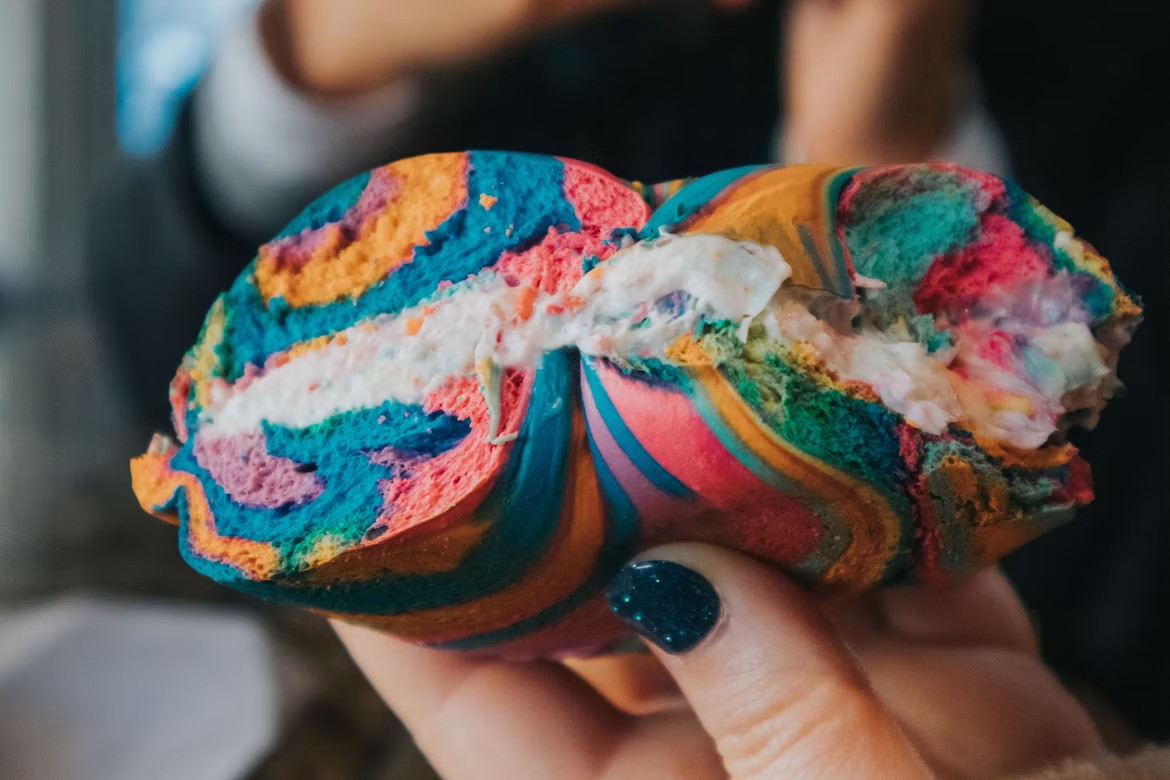
- Ten years ago, Grub Street dubbed the phenomenon of people waiting extraordinary lengths of time for rainbow bagels, freakshakes and other social–media–friendly foods “The Great Line Apocalypse.”
- Last year, the BBC asked why travellers queue for hours for viral food. I talked about it at the time – the fact that food trends reshaping travel is not new.
- This year there are academic studies with titles like “From TikTok feeds to food queues: social-media-induced food tourism and tourist behaviour in Amsterdam“
Experts pointed to FOMO, social proof and performance culture. They aren’t wrong. But there’s another story underneath the queues and clicks – one with wider implications for destinations, the people who live there and the tourism sector itself.
The crowding.
Discussions about overtourism often conjure images of historic city centres overwhelmed by visitors: Venice, Barcelona and Amsterdam. Crowds filling medieval squares. Hours–long lines wrapping around iconic landmarks.
But overtourism isn’t simply about enormous numbers of people visiting a city. It is a problem of compression: too many people in too little space at the same time.
And sometimes that space is the pavement outside a bakery that suddenly gets hundreds of visitors a day because its enormous croissant, or luridly coloured confection has been deemed worthy by the algorithm.
Viral food creates micro–overtourism.
People who might otherwise disperse throughout a city instead converge on a space that can’t accommodate them because they all saw the same video telling them, “you need to try this.”
The irony is that dispersal, encouraging visitors to spread themselves across different places and different times, is a strategy that destinations use to manage overtourism. But while tourism planners talk about dispersal, algorithms reward concentration.
At street level, that compression has very ordinary consequences. Pavements become queuing systems. Doorways become photo opportunities. Residents and neighbouring businesses find themselves negotiating crowds that the street was never designed to accommodate. A shop may have become a tourist attraction overnight, but the pavement, bins, transport links and people living above it haven’t.
If only the inconveniently blocked pavement was the end of the problem.
Businesses respond to demand, to what attracts customers. When spectacle and clicks reliably produce queues and coverage, the incentive to produce more spectacle and get more clicks is hard to ignore. A bakery making traditional regional specialties suddenly exists in the same competitive landscape as one selling a flaky rainbowed monstrosity the size of a house cat.
The algorithm does not particularly care which tastes better or which tells you more about the place you are visiting. It only cares which one stops your scrolling.
The result of this race for clicks can be a peculiar flattening of travel. The destinations remain different; increasingly, the way we experience them does not.
The viral–food ritual looks remarkably cookie cutter whether you are in London, New York, Amsterdam or Barcelona. Find the trending product. Join the queue. Make the purchase. Post the evidence.
The slide–projector era of travel feels incredibly quaint now – people returning home and boring friends with blurry photographs of monuments over martinis and shrimp cocktails. We have streamlined the process considerably by performing our holidays in real time.
Food makes a particularly effective prop because it offers proof not only that we went somewhere, but that we knew what to do when we got there. The snack is the participation trophy; the photograph the receipt.
None of which means viral food is automatically bad. Some of it is no doubt delicious and we shouldn’t lament independent businesses achieving success through social media. The food itself isn’t the problem and neither – goodness knows – is the success.
The problem – and the great irony – is that algorithm-driven travel and AI search promise personalised recommendations while sending thousands of people to exactly the same place – creating micro-overtourism while diluting opportunities for genuine, personal discovery.
A line isn’t proof of good food and good food isn’t always photogenic. A neighbourhood café, a simple pastry, a regional dish or a family–run restaurant may not generate thousands of likes, but it can tell you something about the everyday rhythms of the place you have travelled to see.
Using the “Tuesday test”
A few years ago, I started asking myself a question when travelling: if I lived here, where would I eat on a typical Tuesday?
I found it a really useful way to break free of the social media checklist mentality and find space in a trip for personal discovery.
My recommended antidote to culinary FOMO? Walk twenty paces away from the queue. Turn a corner. Look at another menu. Ask someone who lives there. Try the bakery you happen to pass rather than the one that has appeared seventeen times in your feed.
You might still decide the viral croissant is worth two hours of your life. You do you. At least it was your decision.
But travel experiences become deeper, more personal and unique to you when food isn’t treated as a trophy or something to collect and is treated as something to taste, learn about and enjoy.
And in an age when travel increasingly resembles nothing more than a content creation engine, choosing not to join the line can feel almost rebellious.
Chances are you’ll eat better too.