There’s a lovely custom in Spain. Upon being introduced to someone, the Spanish say “Encantado,” which means “charmed.” It’s far more, well, charming, than the blandly Amer-English “Nice to meet you”. It also perfectly describes my feelings upon being introduced to the gorgeous Mallorcan town of Soller, where I’ve recently spent a nourishing few days eating, drinking, cooking, walking, basking and eating again.
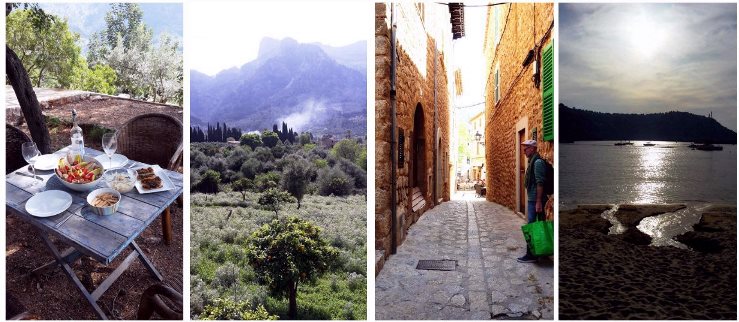
Mallorca is the largest of the Balearic Islands and alongside its better known sister island Ibiza, lies in the Western Mediterranean off the coast of Spain. Ibiza may be the famous party island, but Mallorca is also a very popular holiday destination – known not only for the party resort of Magaluf in the South, but also for the super-elite enclave of Deia on the Northern coast, and the capital Palma. Millions of tourists, led by the Germans, the British, and Swedes (as well as the Spanish themselves) descend on Mallorca every year, drawn by the scorching Mediterranean summers and extremely mild winters. It should surprise no one that many visitors wind up settling there.
So it was with two dear friends of mine – whom I shall call Aaron and Thomas, a wonderful British/French couple who had tired of the cold grey drudge of London, and were looking for a new life and home. But they weren’t looking for your average Med resort living. Not for them the beach-side tower blocks or cafes serving egg and chips. They were after something quieter, freer, more natural. A chance holiday to visit a friend in the northern Mallorcan town of Soller, and they instantly knew their search was over. Five years later, they were hosting me at their beautiful home in the hills above the town.
It’s not hard to see why they were instantly smitten by Soller. Nestled in a narrow valley of the rugged Serra Tramuntana mountains that run the length of Mallorca, this town of less than 14,000 inhabitants manages to simultaneously give the impression of great visual drama and deep soulful serenity.
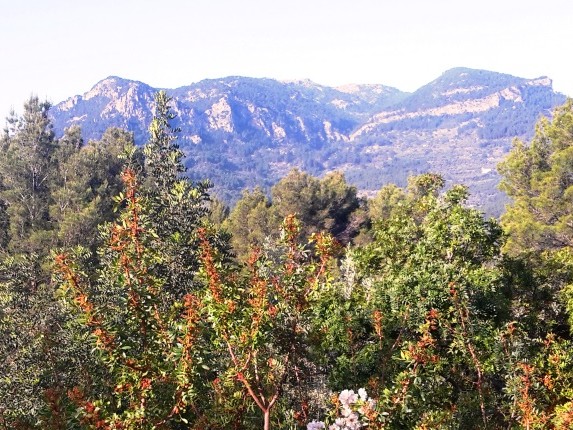
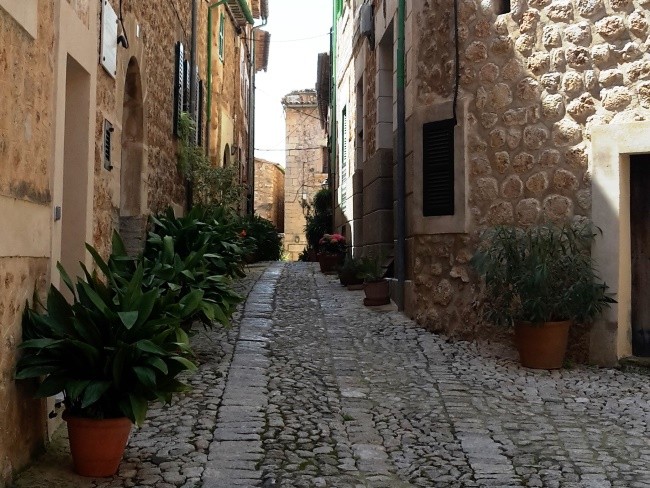
Dense woodland and jagged escarpments on the mountains above the town descend precipitously to ancient stone-walled terraces of olive and almond trees. The buildings of the town, many of which date back to the 16th century and line the narrow serpentine streets, are all built of a local stone the colour of pale apricots.
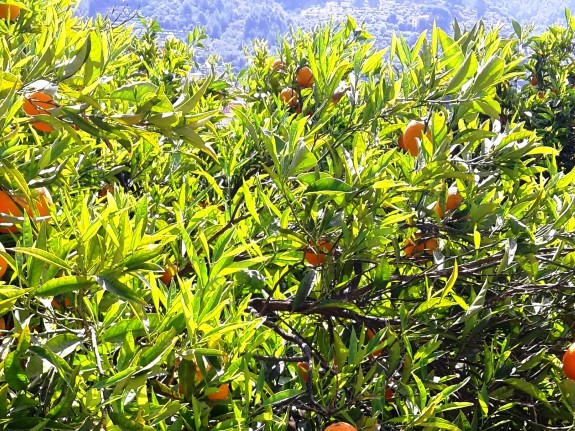
These streets all converge on a leafy town square that plays host to an abundant Saturday market. Surrounding the town is a veritable sea of orange and lemon groves. They’re absolutely everywhere, and the scent of orange blossom perfumes the air, even wafting occasionally up into the hills above.
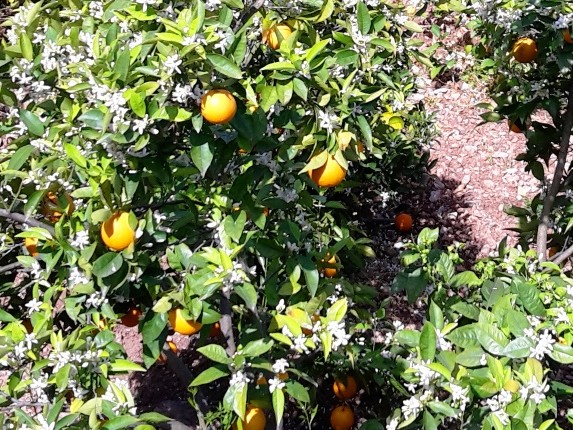
Not for nothing is the valley known as “The Valley Of The Oranges” or “The Golden Valley”. Indeed those fruits were for many years the source of wealth for the town. Even now, in just about every cafe you are treated to the freshest, most delicious orange juice you’ll ever taste, from trees that seem to blossom and fruit all year round.
All this beauty is relatively unspoiled by the mark of modern times. Yes, there is the odd supermarket petrol station and such, but these are discretely slipped into their environs. Very strict building regulations in this protected area mean no new building is allowed outside the town itself, and any restorations or alterations to existing buildings must be done with the greatest sympathy. Fincas (or farmhouses) cannot be made taller, traditional building methods and materials must be used, and although the builing of swimming pools is allowed, pale or turquoise tiling of the pools is not. Basically, you can have a pool as long as it doesn’t look like a pool. This also means that there are no big resort hotels in the town or its environs; nothing so large and vulgar would be allowed here. Instead, Soller plays host to a growing number of boutique hotels built within existing mansions, whose smaller sizes and more “niche” clienteles, will hopefully have a less detrimental effect on a town that has so far welcomed an eclectic expat community from several countries while never losing its unique “Mallorqui” character.
It was at one of the best of these boutique hotels, the Hotel Salvia that Aaron and Thomas took me to dine the night I arrived. And what an introduction to Mallorcan cuisine it was. The hotelis located in the old town of Soller, in a 19th century townhouse with gardens that look out onto the cliffs that tower over the town. We dined outside on the terrace of the Salvia a la Carte Restaurant, as the cliffs were painted rose by the sunset and the jasmine that clings to the stone walls of the garden scented the breeze. Sadly, my greed and the delicious aromas of the dishes we were presented precluded me from taking pictures of our meal, but starters of fried octopus with citrus and chicory, the lightest duck liver terrine with a lavender ice cream, and even a broccoli tartare were all stunning. And they were as nothing compared a main dish of Negrito, a local Mallorcan fish best described as a slightly meatier sea bass, served with a prawn carpaccio and fregola, that may have changed my life forever. I would move to Mallorca simply to eat this dish – and this fish – again and again and again. At boutique hotel prices, lord knows how I’d pay for it, but I know it would be worth it. This delicious meal was washed down with more than one bottle of Verdejo de Rueda, a gorgeously crisp and fresh Spanish white wine, blended mostly from a native Spanish grape, the Verdejo (not to be confused with the equally delicious Italian Verdicchio).
If dinner on my first night was the epitome of restaurant glamour, breakfast the next morning was rustic simplicity itself. Aaron’s homemade fig jam on his sourdough caraway bread- and all the more delightful for being served on their terrace with a panoramic view of Soller and the surrounding mountains. Perfect fuel for a walk to the monastery of Sa Capalleta, with its gorgeous little secluded chapel.
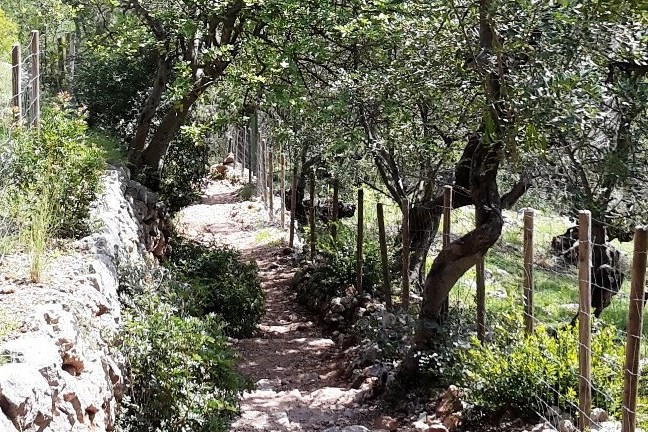
From Sa Capalleta it was down the winding path into Soller for a wander around town in the Spring sunshine and then a stop for lunch at Es Ferreret, the tiniest cafe I’ve even. Basically a window in the wall of the Mercado Municipal, it’s run by the lovely Ann, who served me a delicious mushroom quiche and, of course, fresh squeezed orange juice.
Now a good guest attempts to repay such generous hospitality, so that evening I made dinner for the boys. I opted, inevitably, for one of my Spatchies (estoy un hombre obsesionado), and I thought in honour of Soller and all things Spanish, I’d make it a Spanish Spatchie! So I marinated it (under the skin, not over, most important) in a paste made of orange rind and juice, garlic, rosemary, pimenton (Spanish smoked paprika) and olive oil, and roasted it with orange segments and butternut squash seasoned with pimenton picante.
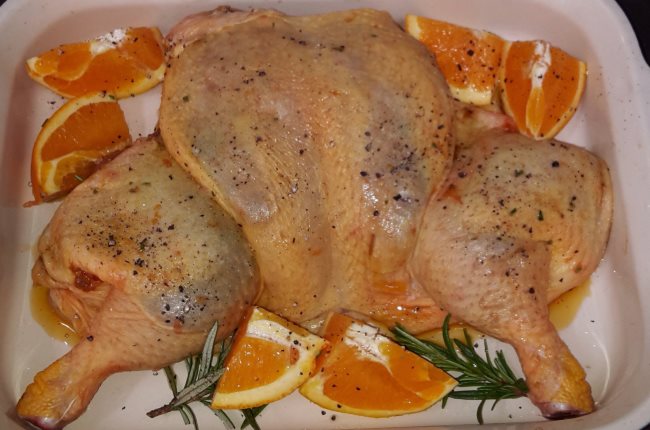
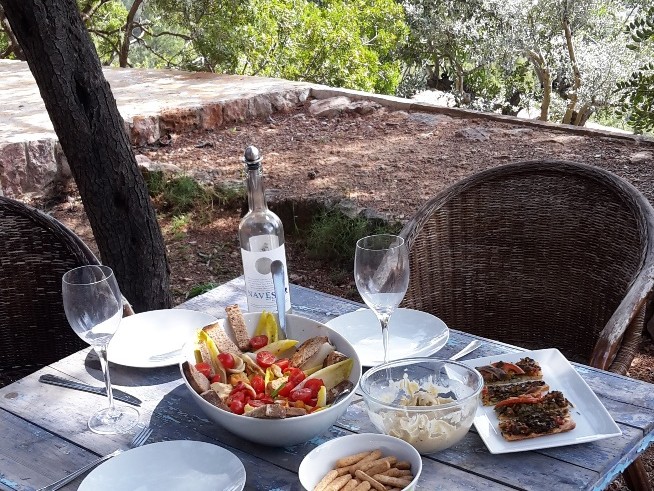
It turned out rather well, with enough leftovers to serve as the base for a lunch on the terrace the next day. That lunch was a salad made from the leftover chicken and squash, with endive, roasted peppers, tomatoes, spring onions and sourdough croutons in an orange and dill vinaigrette. A glass or three of more ice cold Verdejo was the perfect accompaniment for an al fresco lunch under the carob tree, with a spectacular view.
Now so far I had eaten delicious Spanish food and sumptuous Spanish wine, but, that amazing Negrito and the native oranges aside, none of it had been specifically Mallorqui. I was eager to try traditional Mallorcan cuisine, and I had come in search of the coca de trampo, the ensaimada, and the sobresada pasta. I was not destined to be disappointed.
The terraces of olive and almond groves that clothe the foothills of the Sierra Tramuntana above Soller are interlaced with pathways that have been trod for almost a thousand years. One of these paths took us from Aaron and Thomas’s property past fincas and orchards and up into the forest before ending in the tiny village of Fornalutx. Named as one of the 5 most beautiful villages in Spain, Fornalutx clings to the side of one mountain whilst facing across a narrow valley to the vertiginous face of another. Its famous beauty has made it popular with tourists, so there was quite a queue of us foreigners at the little local bakery where I was able to fulfill two of my three culinary quests.
The coca de trampo (or just coca, really) and the ensaimada are both pastries of a sort, but they couldn’t be more different. The coca is essentially a vegetable tart; an olive oil enriched dough baked into a rectangular shape (much like a pizza), and topped with a variety of vegetables. Found everywhere in Soller, it’s a street food staple for lunch or snacks for locals and tourists alike. Mine came topped with chopped anchovies and something that suspiciously resembled crispy kale, but was no less tasty a savoury treat for that.
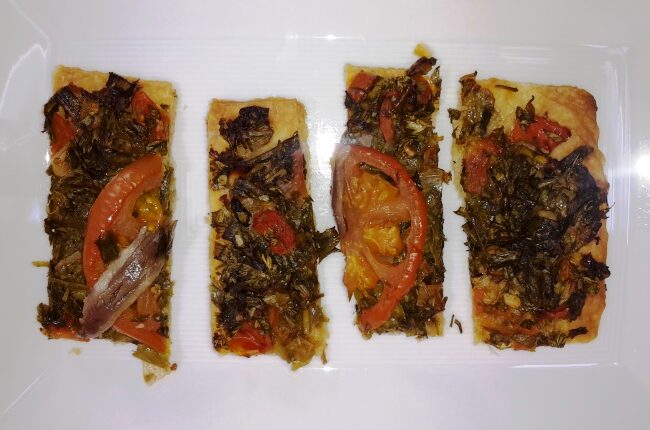
The ensaimada, on the other hand, is more of a desayuno (breakfast) pastry, sweet and very unusual. It’s made from strong flour, eggs, sugar, water, a fermentation starter (much like a sourdough starter) and, well, pork lard. The resulting dough is then rolled and coiled before being baked and dusted with icing sugar. It makes for a slightly dense pastry, with a texture not unlike brioche, and can be filled with cream, or chocolate or turron ( a form of nougat), or just served, as mine was, plain. Unusual it may be, but I found it delicious. It went beautifully with a nice cup of tea for a late afternoon snack, and I’ll bet would make a delightful desayuno indeed.
My last day in Soller coincided with market day for the town. The normally rather quiet streets around the town square and up toward the train station were brimming with people and lined with an almost endless parade of stalls and trucks selling an almost impossible variety of viands and victuals, as well as pottery and all manner of carved wooden cutlery and serving ware.
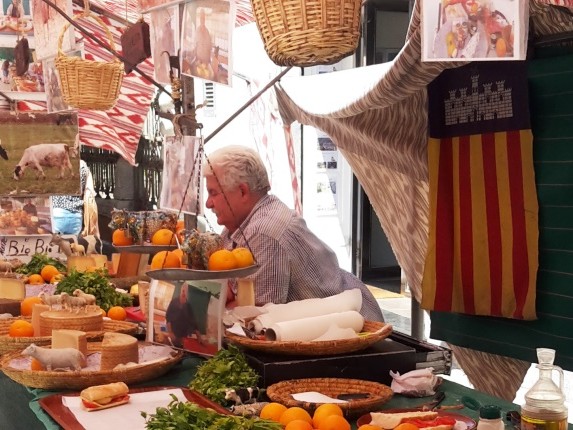
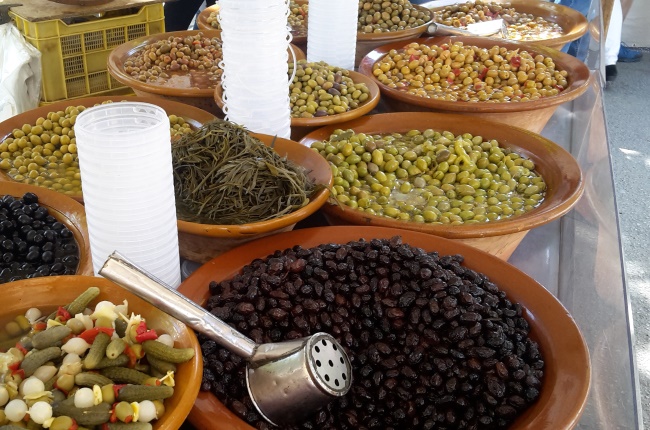
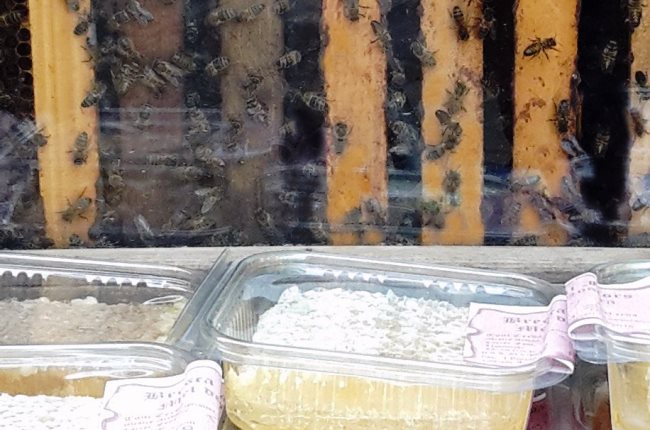
There was a stand for honey, complete with a hive, an enormous stand filled with every kind of olive imaginable, alongside pickled cebollitas (baby onions) and pimientos and cured beans and almonds. There were stands bedecked with various Spanish sausages; stands for cheeses and breads, local snails, and an extremely popular truck selling a veritable feast of meats and cheeses.
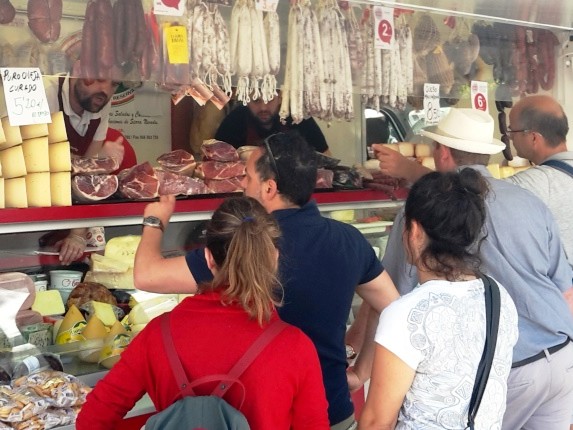
All this to the accompaniment of a small local band playing folk music. To walk among the stands and just gaze at the wealth and quality of local produce, and to see how the Mallorcans shopped, what they queued for and what they passed by, was more of an education about this town and its people than anything one could ever read in a book, and nourishing for the soul of this particular foodie.
The market also provided temporal nourishment, as it provided us with ingredients for our final lunch. At one stall I found my sobresada pasta, and at another Aaron found some pimientos padrones. Alongside some tortilla con cebollas (Spanish omelette with onions), picos de pan (tiny breadsticks) and hummus (not remotely Mallorcan or even Spanish, but Aaron makes some damn fine hummus) the pimientos padrones (tiny little green peppers simply fried whole in olive oil and salt) and the sobresada pasta made for delicious tapas on the terrace.
What is sobresada pasta? Well it’s not a noodle. Sobresada is a uniquely Mallorcan delicacy, a pate made from minced pork cure with pimenton and garlic. It can be sold in sausage form, but that sausage is usually then sliced open and the filling spread on bread. It’s like a spreadable chorizo, but with a loose texture that’s initially a tad alarming. As the pork is cured rather than cooked, the initial impression is of eating raw meat. But of course you’re not, and once you get over the mental block it’s simply stunning. I ate it spread on bread, but can well imagine (even dream) of it being used to coat pasta, or paired with a hard cheese, or even on scrambled eggs. My quest for these three Mallorcan food staples had been blissfully fulfilled.
For my final evening in Mallorca, Aaron and Thomas took me to Port de Soller, a little seaside village three kilometers from Soller town and connected to it via a sweet little wooden tram. Port de Soller is located in a tiny natural horseshoe of a harbour, and while more obviously “developed” than its inland sister town, with a number of hotels and restaurants lining the waterfront, still has abundant charm. Minibar, a tiny yet effortlessly chic little bar a level up from the street was the perfect spot from which to watch the sunset, and to sip a sundowner of Mallorcan Gin.
It’s not just Britain that’s been bigging up the gin for the last several years. Artisanal gins, with unique flavour profiles and new takes on botanicals, have been springing up all over the world. Mallorca is no exception; indeed its sister island Menorca has been producing a world-standard gin for decades. Xorigeur Mahon Gin is one of the few gins in the world to actually earn a Geographical Indication. The Esperit de Mallorca, a small producer based in the Serra Tramuntanas above Soller, have developed a range of gins to reflect the flavours of Mallorca. I tried the Cabraboc (which seems to mean “Old Goat” in Catalan- go figure) and tonic. It didn’t disappoint. The usual gin flavours (juniper, coriander) were enhanced and shaded with notes of fennel and orange peel and a whiff of lemon verbena.
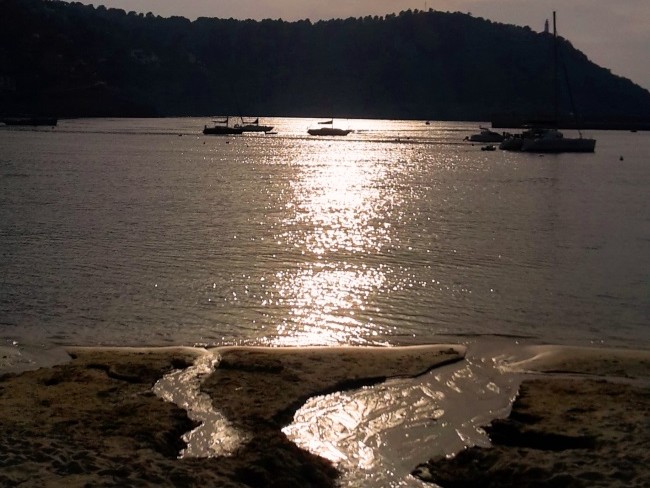
That sundowner was the perfect aperitif before my final dinner on the island, at a brilliant beachside cafe bar called Es Reco. We ate a selection of tapas including the traditional patatas bravas and chiperones fritos (whole baby squid fried in batter- to die for) followed by gambas al ajillo- prawns fried in garlic. We washed this delicious (but sad for me) down with a bottle of Ramon Bilbao Rosado, a delicious rose Rioja made from the Garnacha grape (that’s Grenache, a grape as popular in France as it is in Spain.). It was a bittersweet final meal in this delightful town, each delicious mouthful bringing me close to bed time and a sad journey home on the morrow.
It was indeed a sad journey home the next day, though a mercifully brief one. Mallorca is only two hours from the UK by plane. Increasingly regular flights at very reasonable rates (if you book with a degree of foresight) make getting there very easy. I fully intend to revisit Soller in particular, not just to enjoy once again the tremendous hospitality (and stunning home) of my friends Aaron and Thomas, but to further explore the Mallorcan dishes I’ve yet to try (Arroz brut, panadas, Frito Mallorquin, Lechona, Pa Amb Oli, I could go on), and just bask once again in the special orange blossom beauty of this special little town.
Encantado, Soller, encantado.